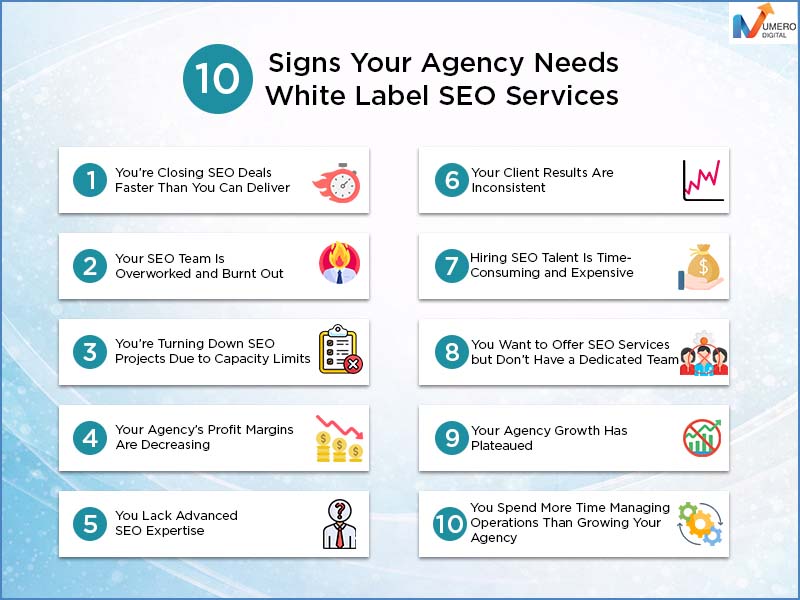

These days, managing a digital agency frequently feels like juggling ten different things at once.
A website redesign is required for one client. Another desires sponsored advertisements. A third inquires about social media tactics. “Can you help us rank on Google?” is a request that nearly every agency eventually receives.
In digital marketing, search engine optimization is now one of the most sought-after services. Because organic search consistently generates qualified traffic, businesses in all sectors are making significant investments in it. According to studies, over 50% of website traffic for many businesses comes from organic search, making SEO one of the most effective long-term growth strategies.
However, it takes more than just adding a line to your service page to offer SEO services.
In contrast to web design or paid advertising, SEO requires collaboration between several disciplines. Successful campaigns include technical audits, keyword research, content production, on-page optimization, backlink building, analytics, and continuous monitoring.
Establishing an internal SEO department is similar to putting together an orchestra. You can’t depend on a single musician. Technical experts are needed to fix site problems, writers are needed to produce optimized content, outreach specialists are needed to develop authority through backlinks, and strategists are needed to oversee the campaign.
Putting that team together costs many agencies a lot of money. It can easily cost between $150,000 and $250,000 a year to hire seasoned SEO specialists, buy cutting-edge tools, and maintain the infrastructure needed to run campaigns.
That level of investment frequently poses a challenge for expanding agencies. Customers want SEO services, but it may not be feasible to hire an entire internal team.
For this reason, a lot of prosperous agencies are using scalable SEO delivery models, which enable them to provide full optimization services without developing a sizable internal department.
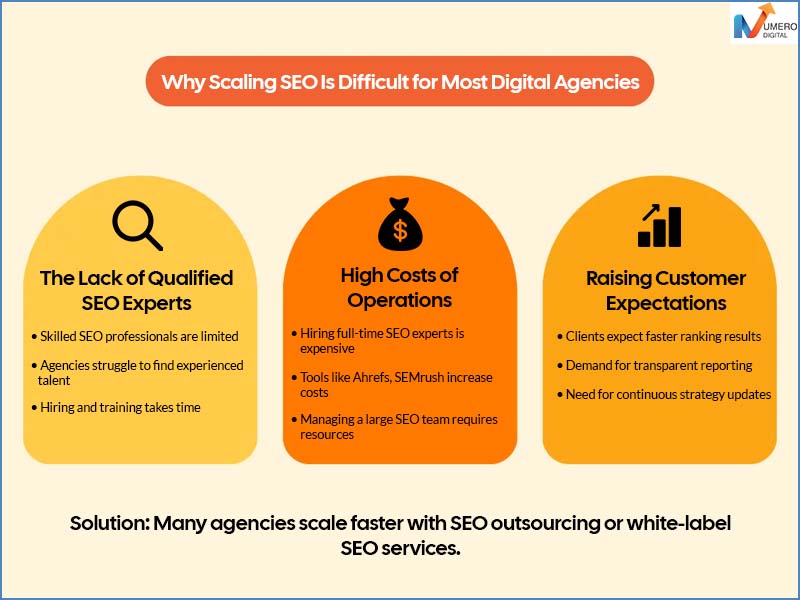
Why Scaling SEO Is Difficult for Most Digital Agencies
At first glance, it seems like a sensible move for agencies hoping to expand into SEO. Most businesses require organic search services, and clients already have faith in the agency.
However, agencies soon find that scaling these services is much more difficult than anticipated once they start delivering SEO campaigns internally.
The Lack of Qualified SEO Experts
Finding qualified SEO talent is one of the main challenges agencies face.
Technical website optimization, content strategy, analytics, and search engine algorithm updates are just a few of the many fields that SEO experts need to be knowledgeable about. The best experts are highly sought after in the job market because they combine marketing knowledge with analytical thinking.
Established marketing firms, SaaS companies, and large corporations all vie for the same pool of skilled workers. Because of this, it can take months to find qualified SEO strategists, and the pay needed to recruit them keeps going up.
Hiring these experts can strain budgets and slow growth for small and mid-sized organizations.
High Costs of Operations
Maintaining an internal team requires continuous investment, even when agencies are successful in hiring SEO specialists.
Many roles collaborate in an efficient SEO department. A strategist creates campaign strategies and monitors results. Content creators create landing pages and articles that are optimized. Technical experts handle indexing and site-structure issues. Through partnerships and outreach, link-building specialists establish authority.
The total operational cost of providing SEO services increases with each role.
To conduct technical site audits, backlink monitoring, competitor analysis, and keyword research, agencies must also invest in high-end tools. Enterprise SEO software, analytics tools, and reporting dashboards are examples of platforms that can cost thousands of dollars annually.
Even a small internal SEO team can represent a substantial financial commitment when all these factors are considered.
Also Read – The Future of White Label SEO in the AI Search Era
Raising Customer Expectations
The growing complexity of search marketing is another factor making SEO challenging to scale internally.
Ten years ago, basic keyword optimization was a common focus of SEO campaigns. Clients now demand all-encompassing approaches, such as thorough technical site audits.
- Superior long-form content
- Organized internal linking techniques and backlink campaigns that increase authority
- Performance insights and ongoing analytics reporting
The sophistication of search engines has increased. Algorithms assess hundreds of signals, including user experience, domain authority, content quality, and site performance.
Agencies must consistently deliver excellent optimization work across a variety of specializations to meet these demands. Internal performance at that level might quickly strain available resources.
The Hidden Bottleneck Agencies Encounter
As their firms expand, many agency owners experience a similar turning point.
Requests for SEO services start coming in frequently for a marketing or web design firm. New prospects want to know whether the firm can help boost organic traffic, while current clients want to improve their search rankings.
There is a demand. SEO retainers frequently improve client relationships and generate recurring monthly income.
However, providing these services domestically is difficult.
It could seem hazardous to hire an entire SEO team right away, particularly if the agency is still expanding its clientele. Refusing SEO tasks, however, means missing out on important cash prospects.
Because of this, there is a bottleneck in which agencies have market demand but lack the operational capacity to meet it.
Many agencies search for alternative delivery methods that enable them to fulfill demand while preserving operational efficiency, rather than having to choose between increasing payroll or turning away clients.
Three Common Ways Agencies Deliver SEO Services
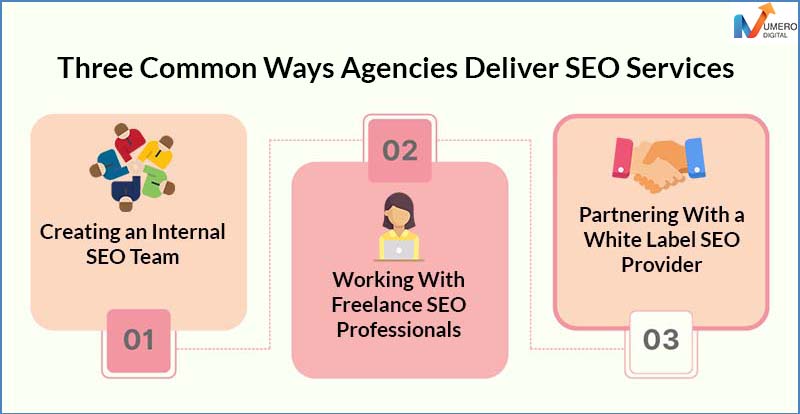
Agencies usually use one of three operational approaches to get around the problem of scaling SEO. Depending on the agency’s size, resources, and growth strategy, each model has benefits and drawbacks.
Creating an Internal SEO Team
Creating an entirely in-house SEO department is the most conventional strategy.
Agencies that use this model employ experts who are solely employed by the organization. This gives you direct control over communication, quality control, and campaign strategy.
Designers, developers, and marketing strategists frequently work closely with internal teams. This degree of cooperation can help agencies create campaigns tailored to each client.
But there are also a lot of difficulties with this model.
It takes time and money to hire several experts. Ongoing management is necessary to keep procedures consistent and train new team members. Agencies must continually expand their internal staff to meet demand as the clientele grows.
Scaling through internal hires is expensive and time-consuming.
Working With Freelance SEO Professionals
To close resource gaps, some companies work with independent contractors.
Certain tasks, such as content creation, technical audits, and keyword research, can be assisted by freelance SEO specialists. This approach allows agencies to handle workloads without hiring full-time employees.
Freelancers may be useful for short-term projects because they provide flexibility.
However, managing multiple independent contractors often creates new challenges. The availability of each freelancer may vary depending on their schedule. Quality may change as projects get more complicated, and it may be difficult to communicate with multiple contractors.
For businesses with a large clientele, managing multiple independent contractors may become ineffective.
Partnering With a White Label SEO Provider
Working with a white-label SEO company is becoming a more and more common option.
With this arrangement, companies can outsource the operational work to a specialist team while still providing comprehensive SEO services. While the white label partner handles the technical implementation behind the scenes, the agency upholds the client relationship and offers the service under its own brand.
It is helpful to consider manufacturing collaborations in other industries to comprehend how this operates.
A technological corporation might create a product, sell it directly to consumers, and market it under its own brand. However, a specialist production partner with state-of-the-art facilities and knowledge may produce the product itself.
The manufacturing partner concentrates on production, while the brand concentrates on strategy, marketing, and consumer relations.
The structure of white-label SEO is comparable. While specialist teams carry out the optimization work necessary to produce results, agencies oversee client relationships and strategic direction.
Understanding White Label SEO
A partnership strategy known as “white label SEO” allows an agency to display the work under its own brand identification while an outside source handles SEO services on its behalf.
The agency remains the primary service provider from the client’s perspective. The agency itself usually provides all reporting, communication, and strategic direction.
The white-label partner works behind the scenes on tasks like thorough SEO assessments. Such as:
- Keyword analysis
- Plan creation
- On-page content optimization
- Backlink building
- Outreach
- White Label Technical SEO Audit enhancements
- Analytics and reporting
Agencies can grow their services using this model without hiring a full-time staff.
Agencies can rely on seasoned SEO specialists who already have established procedures and competence rather than employing numerous specialists and handling intricate workflows internally.
How White Label Partnerships Enable Scalable Growth

Scalability is one of the main reasons agencies choose white-label SEO.
As their clientele increases, traditional employment practices encourage agencies to expand their workforce. Every new SEO client increases the amount of internal work.
This restriction is lifted through white-label collaborations.
The external SEO staff can easily take on the duty when an agency acquires a new customer. While the partner manages the execution necessary to accomplish those goals, the agency continues to manage client relationships, set campaign goals, and communicate progress.
This creates a streamlined operational workflow.
First, the agency acquires a new SEO client and defines campaign objectives. The white label partner then performs the necessary optimization work, including research, technical improvements, and content development. Progress reports are generated and delivered to the agency, which shares insights and updates with the client.
Because the operational work is handled externally, agencies can focus on business growth rather than resource management.
Why More Agencies Are Outsourcing SEO

The trend toward outsourcing SEO delivery is indicative of more significant developments in the digital marketing sector.
Delivering successful SEO campaigns demands in-depth knowledge across several disciplines as search engine algorithms become more complex. Agencies are increasingly realizing that keeping this knowledge in-house might not always be the best course of action, especially as areas like LLM SEO require specialized expertise.
According to industry surveys, a sizable portion of digital businesses contract out at least some of their SEO work to outside experts.
This tendency is caused by several factors.
First, agencies can swiftly expand services thanks to outsourcing. Through a reputable partner, firms can start providing SEO services almost immediately rather than spending months hiring experts and developing internal procedures.
Outsourcing also lowers financial risk. Agencies avoid the long-term pay obligations that come with hiring full-time staff. Operational expenses remain adaptable and in line with the current number of customers.
Third, outsourcing gives you access to seasoned experts who focus just on search optimization. Teams of strategists, technical experts, content specialists, and outreach specialists who work only on SEO campaigns are frequently maintained by white-label SEO firms.
Lastly, outsourcing frees up agencies to concentrate on tasks that promote company expansion. Managing daily optimization chores frequently has a shorter-term impact than sales, marketing, and customer relationship management.
Situations Where Outsourcing SEO Makes Sense
Even though some big agencies have entirely internal SEO departments, there are a number of circumstances where outsourcing is especially beneficial.
As their clientele grows, agencies frequently see an increase in demand for SEO services. Current customers who rely on the agency for advertising or web design may ask for help with organic search results.
Outsourcing offers a workable solution in these situations, including SEO services, without impeding expansion.
Additionally, agencies might not have internal SEO specialists. Teams that concentrate on development, design, or paid advertising might lack the technical expertise needed for intricate search optimization initiatives.
Through outsourcing, organizations can add outside expertise to their current skill set.
Another typical situation is when hiring seasoned SEO specialists becomes challenging or costly. Competitive salaries may surpass available funds, and recruitment cycles may be drawn out.
Agencies can avoid these difficulties and still produce campaigns of the highest caliber by outsourcing.
Choosing the Right White Label SEO Partner

Although outsourcing SEO has many benefits, choosing the right partner is crucial to this model’s success.
Agencies should thoroughly assess potential suppliers to ensure they can deliver reliable outcomes.
One of the most crucial elements is experience. A trustworthy partner should have a track record of completing SEO campaigns in a variety of industries. Examining case studies, performance information, and client endorsements can shed light on their abilities.
Transparency is equally crucial. Agencies can track campaign performance and maintain client confidence when presenting results thanks to clear communication and thorough reporting.
Scalability needs to be considered. SEO partners must be able to manage heavier workloads without sacrificing quality as agencies expand.
Lastly, agencies could benefit from collaborating with suppliers focused on helping other agencies. These partners frequently create their procedures especially for white-label partnerships, which facilitates easier and more effective integration.
Scaling SEO Without Expanding Your Payroll

Growth often presents both opportunities and complexities for digital agencies.
SEO remains one of the most valuable services in digital marketing, and clients expect agencies to offer a broader range of services. However, creating an internal SEO department may require a significant financial investment and operational oversight.
For this reason, many organizations are implementing scalable service models that enable them to expand their offerings without significantly increasing staff.
While concentrating their internal resources on strategy and expansion, agencies can deliver comprehensive optimization campaigns, serve more clients, and maintain high service quality by collaborating with specialized SEO providers.
Numero Digital’s solutions give agencies a way to scale SEO services without the difficulties of creating and overseeing an entire internal staff.
FAQs
What does it mean to scale SEO services for a digital agency?
Increasing the number of SEO clients an agency can serve without correspondingly raising internal resources or operating costs is known as scaling SEO services. Agencies accomplish this by streamlining procedures, utilizing automation tools, or collaborating with outside SEO companies to oversee the implementation of SEO campaigns.
Can digital agencies offer SEO services without hiring SEO experts?
Indeed. By collaborating with specialized providers who manage SEO execution behind the scenes, many digital agencies can provide SEO services without employing internal staff. This method enables agencies to concentrate on strategy, client communication, and business expansion while providing SEO services under their own brand.
Is outsourcing SEO common for digital marketing agencies?
Indeed, a common tactic used by digital marketing firms is outsourcing SEO. To provide high-quality SEO services while retaining operational efficiency, many agencies outsource tasks such as technical SEO, link building, and content optimization to specialist teams.
What are the benefits of outsourcing SEO instead of building an in-house team?
Lower operating expenses, faster service expansion, access to seasoned SEO experts, and the ability to scale services quickly are just a few benefits of outsourcing SEO. Instead of maintaining intricate internal SEO operations, agencies may focus more on building relationships and gaining new clients.
What is white-label SEO?
White-label SEO is a service model in which an agency uses an outside SEO company to handle optimization tasks while marketing the services under its own name. This enables companies to provide clients with all-inclusive SEO solutions without having to create or oversee an entire internal SEO team.
How do agencies maintain quality when outsourcing SEO?
By collaborating with seasoned SEO companies that provide clear procedures, thorough reporting, and proven tactics, agencies can maintain quality. Consistent client outcomes can also be ensured through performance monitoring, clear expectations, and regular communication.
Is white-label SEO profitable for agencies?
Indeed, agencies may make a lot of money from white-label SEO. The agency can expand its service offerings and achieve strong profit margins without significant operational investment, as it maintains control over pricing and client relationships while outsourcing fulfillment.
When should an agency consider outsourcing SEO services?
When client demand rises, internal resources become scarce, or employing seasoned SEO specialists becomes too expensive or time-consuming, an agency should think about outsourcing SEO. Agencies can maintain continuous delivery while rapidly expanding their services through outsourcing.