
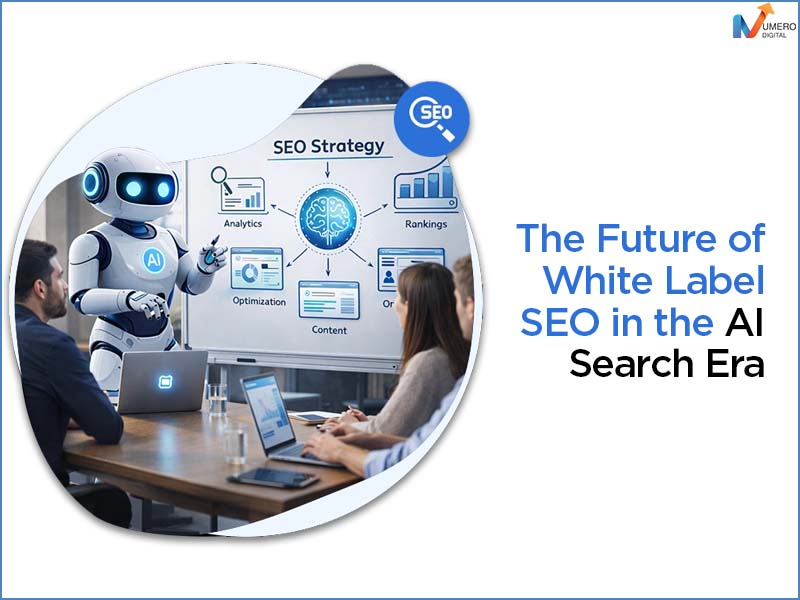
Introduction: SEO Isn’t What It Used to Be
The ultimate goal of SEO was once to rank #1 on Google. You would ascend the SERPs, take a comfortable seat at the top, and observe the influx of traffic. Easy, huh? No longer.
Welcome to the AI search era, where answer engines, zero-click searches, and Google’s AI Overviews are subtly reducing your organic traffic. Without even going to your website, users are receiving answers. This implies that your clients may experience a decline in clicks even if they rank highly.
This change is a wake-up call for agencies, not just a fad. Customers continue to demand better ROI, quicker turnaround times, and results. However, conventional SEO processes? To be honest, they were not designed for this new reality and are too slow and manual.
This is precisely where AI-powered white-label SEO comes into play. These days, it’s not just about outsourcing; it’s also about delivering more quickly, scaling more intelligently, and remaining competitive in a market that is constantly evolving.
We’ll discuss how white-label SEO is changing in the age of AI search, what works and what doesn’t, and how agencies can future-proof their approach without exhausting their staff in this blog.
Why Traditional SEO is Breaking in the AI Era
To be honest, traditional SEO is still in use, but it is under pressure.
The largest change? The way people search has evolved. With AI-generated answers appearing directly in search results, users don’t always need to click through to websites anymore. Across all industries, this increase in zero-click searches is subtly decreasing organic traffic.
Content saturation is another issue. The internet is now overrun with similar-looking blogs, guides, and landing pages due to AI tools that make content creation absurdly quick. Making an impression is not only challenging but also draining.
Additionally, SEO has become more intricate with the rise of AI SEO services. Backlinks and keywords are no longer the only factors. You now need to consider:
- Search intent
- Content depth
- User experience
- AI visibility
The real kicker is this:
- Being chosen by AI systems is now more important for SEO than simply ranking pages.
What about conventional workflows? They are unable to keep up. AI-driven search ecosystems are simply faster than manual audits, sluggish content creation, and reactive tactics.
This causes a significant bottleneck for agencies managing several clients. Less time, more work, and more pressure to produce outcomes.
Because of this, the transition to AI-powered white-label SEO is now unavoidable rather than optional.
What is AI-Driven White Label SEO?
Let’s make this simple—no fluff, no jargon.
When agencies outsource SEO services that are driven by automation, data-driven systems, and artificial intelligence tools—while still producing results under their own brand name—this is known as AI-driven white-label SEO.
Imagine it as improving your backend engine without altering your brand that is visible to the public.
In the past, white-label SEO meant delegating tasks to another team, such as link building, audits, and white label keyword research. AI has now revolutionized the way those tasks are carried out.
In actuality, that looks like this:
Before (Traditional Workflow):
- Researching keywords by hand
- Audits that take a long time
- Weeks to create content
- Optimization in response
Following (AI-Driven Workflow):
- AI-driven clustering of keywords and intent
- Minute-by-minute automated technical audits
- Content produced and refined on a large scale
- Tracking performance in real time
The outcome? Better insights, quicker delivery, and the capacity to grow without continuously adding new team members.
The crucial point is that AI cannot take the role of expertise. It makes it better.
The top white-label SEO companies make sure that the results are not only quick but also efficient by combining human strategy with AI efficiency.
How AI is Transforming White Label SEO
AI is radically changing the way SEO is carried out in the background, not just speeding things up.
To start, keyword research has changed. AI tools now map complete intent clusters rather than just high-volume keywords. This implies that you are creating content ecosystems around what users genuinely want rather than focusing on individual terms.
Technical SEO audits used to take hours, but now they only take minutes. AI is capable of scanning entire websites, identifying problems, and even ranking repairs according to their significance. No more sifting through countless reports.
The major one, content generation at scale, comes next. These days, agencies can swiftly create a lot of content. The twist is that optimization—rather than speed—is the true benefit. AI assists in ensuring that information is initially aligned with search intent, structure, and relevancy.
Real-time optimization is another game-changer. AI technologies continuously monitor rankings, user behavior, and engagement rather than waiting weeks to study performance, enabling prompt modifications.
Predictive SEO is the last option. AI is able to identify patterns and recommend tactics before rivals even realize they exist.
In other words, AI makes SEO proactive rather than reactive, which is a huge benefit for firms looking to stay ahead.
The Real Benefits for Agencies
Let’s discuss the three things that really matter to agencies: profitability, scalability, and performance.
Speed is the main benefit of AI-powered SEO. White label SEO Audits and keyword research are examples of tasks that can now be completed in minutes instead of days. Faster delivery and happy customers result from this.
Scalability comes next. Consider managing 20 clients as opposed to 100 clients without having to greatly expand your crew. AI makes that kind of expansion possible.
There is also an obvious financial benefit. Agencies can lower operating costs without sacrificing output quality by automating repetitive processes. Improved margins are the result of increased efficiency.
Consistency is another underappreciated advantage. AI-driven procedures guarantee consistent execution across several projects and minimize human mistakes. No more inconsistent outcomes between clients.
Not to be overlooked is the competitive advantage. Early adoption of AI by agencies enables them to provide customers with faster insights, better plans, and more quantifiable outcomes.
This is a straightforward situation:
By integrating AI-driven white-label SEO, an agency that now manages 30 clients can handle 60 without having to double its staff.
That goes beyond simple growth. That’s wise scaling.
The Hidden Challenges Agencies Must Watch Out For
Let’s face it: AI isn’t a magic wand.
Over-reliance on content produced by AI is one of the main hazards. Content begins to look the same when everyone uses the same tools. Additionally, sameness is the quickest way to vanish in SEO.
Additionally, there is the problem of quality control. AI is capable of producing material rapidly, but it is not necessarily accurate in terms of nuance, tone, or brand voice. The result may seem generic or, worse, erroneous in the absence of human inspection.
Lack of distinctiveness is another problem. What sets your agency apart if everyone else uses the same AI workflows?
Next is the perception of the client. Some customers continue to have doubts about AI. They may lose faith if they believe they are receiving “automatic work.”
Lastly, there is strategic reliance. Agencies may become exposed if algorithms or platforms change, if they rely too much on AI tools without knowing the underlying strategy.
The harsh reality is as follows:
- Businesses that use AI carelessly will lose customers more quickly than they gain them.
The secret is to use AI intelligently, not just.
Also Read – 10 Signs Your Agency Needs White Label SEO Services
The Hybrid Model: AI + Human Expertise
The true winners are distancing themselves at this point.
AI and humans working together is the future of white-label SEO, not AI vs humans.
AI is extremely potent in the following areas:
- Automation of data analysis, speed, and scalability
However, it is deficient in areas such as:
- Narrative, inventiveness, brand voice, and strategic thinking
Human expertise can help with that.
The most successful organizations are creating hybrid workflows in which people concentrate on refining, planning, and adding depth while AI takes care of the heavy lifting.
Consider it this way:
AI manages:
- Clustering of keywords
- Technical evaluations of content drafts
- Monitoring performance
People manage:
- Client strategy, messaging difference, and content quality
This equilibrium guarantees output that is not just quick but also significant and influential.
In a world where everyone has access to AI, your human layer becomes your biggest competitive advantage.
SEO in the AI Era: GEO, AEO & Beyond
Google is no longer the only factor in SEO, which is a significant change.
These days, ChatGPT, Gemini, and Perplexity are among the platforms that provide users with solutions. This implies that your content is fighting to be chosen as an answer rather than just for rankings.
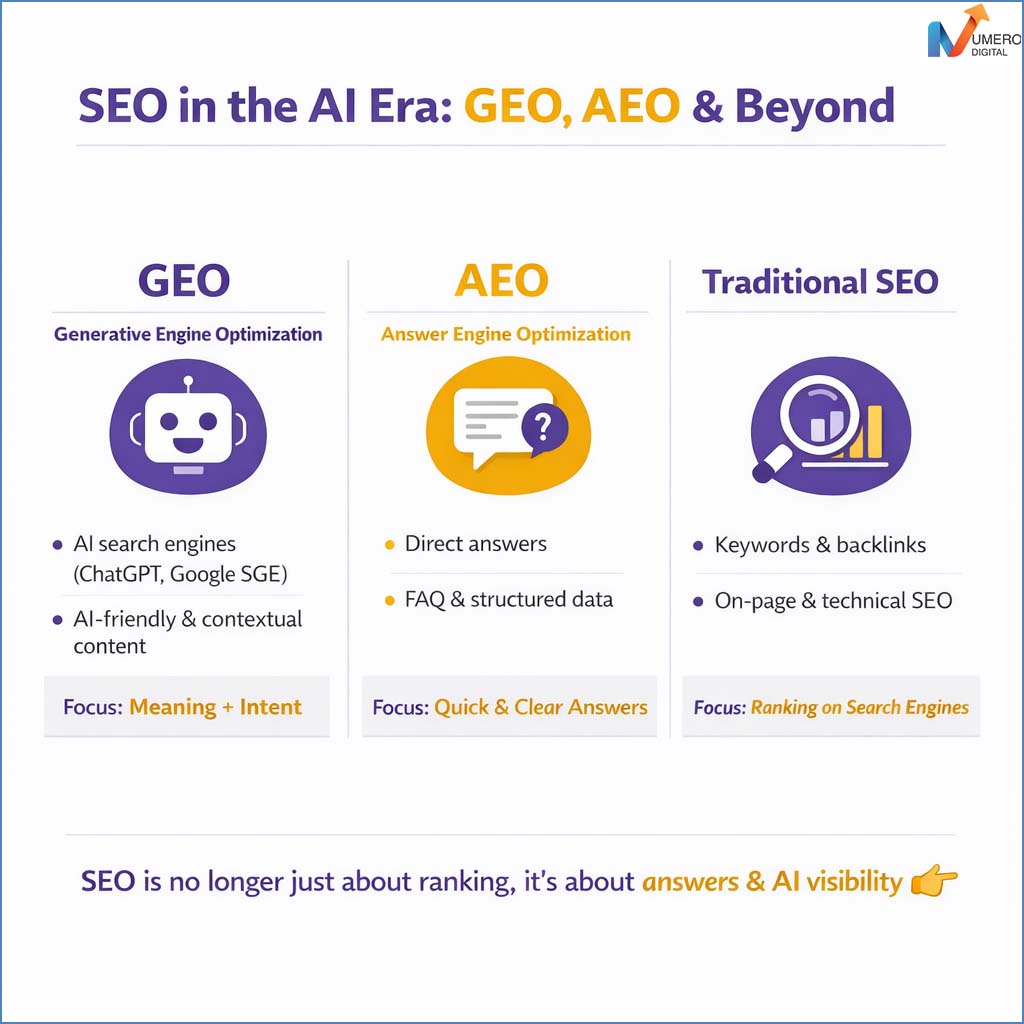
This is where ideas like AEO (Answer Engine Optimization) and GEO (Generative Engine Optimization) are useful.
- GEO specializes in content optimization for search engines powered by artificial intelligence.
- AEO focuses on organizing information so that it can be used as a direct response.
To put it simply, you are now optimizing for visibility inside AI responses rather than just clicks.
This modifies the process of producing content:
- More clear structure
- Succinct responses
- Improved context and greater authority
Early detection of this trend will provide agencies with a significant edge.
Because the future isn’t just about ranking on page one—it’s about being the source AI trusts.
A Practical Framework for Agencies to Adapt
Since strategy without execution is just theory, let’s get realistic.
Agencies can adjust to the AI search era by using this straightforward framework:
Step 1: Examine your present SEO process
Determine the bottlenecks—what is taking too long? Where are you becoming less productive?
Step 2: Strategically incorporate AI tools
Avoid replacing everything at once. Start with high-impact areas, such as keyword research and audits.
Step 3: Create intent-driven content clusters
Go beyond specific terms. Pay attention to user journeys and subjects.
Step 4: Prepare for AI responses
Improve readability, incorporate direct responses, and organize content for clarity.
Step 5: Pay attention to more than just rankings
Measure not just positions but also visibility in AI results, engagement, and conversions.
This is about evolving SEO, not reimagining it.
The Future of White Label SEO
One thing is certain going forward: SEO will get more automated, intelligent, and tailored.
AI will play a major role in search engines’ ability to provide customized results. Visibility on several platforms will be more important than traditional rankings.
Let’s see:
Increased competition for attention, more AI-driven search experiences, deeper personalization, and the standardization of multi-platform optimization
Agencies, too? They will have to immediately adjust.
Here’s a daring forecast:
- Agencies that do not adopt AI-driven SEO will find it difficult to remain relevant in the coming years.
Those who can blend quickness, strategy, and flexibility will rule the future.
Conclusion
The era of AI search is already here, so stop looking at the horizon.
This change offers agencies a chance as well as a task. It will be more difficult for those that continue to use antiquated techniques to compete. However, companies who use AI-powered white label SEO may remain ahead of the curve, scale more quickly, and provide greater outcomes.
Maintaining human knowledge for strategy and creativity while utilizing AI for efficiency is crucial.
We at Numero Digital assist organizations in doing just that. We help businesses scale more effectively, serve more clients, and produce consistent outcomes without sacrificing quality by fusing AI-driven processes with expert-led execution.
Now is the time to take action if you’re prepared to future-proof your SEO approach.